00 Overview
Class 2 asked how many solvent molecules travel with an ion. Class 3 — notebook pages 27–33, lecture of 30 Aug 2026 — asks the next question: when do two oppositely charged ions stop being separate ions at all? The answer is Bjerrum's: below a characteristic distance the electrostatic attraction outweighs thermal motion, and the pair counts as associated.
The distance (Sections 3–6): , where pair energy equals thermal energy . The integral (Sections 7–8): the association constant , built by weighting every shell between closest approach and with the Boltzmann factor. The constant (Sections 9–10): , tied directly to what a conductivity meter reads through .
- Sections 1–2 set up the ion-pair equilibrium and Bjerrum's five assumptions.
- Sections 3–6 derive , the Boltzmann factor, the Bjerrum distance and the association region .
- Sections 7–8 derive and its dimensionless form.
- Sections 9–10 define the associated fraction and connect it to and conductivity.
- Sections 11–16 live calculator, equation sheet, symbol table, rapid revision, raw scans, PYQ audit with the lecture's four solved problems.
01 The ion-pair equilibrium
For an electrolyte that dissociates into a cation and an anion,
the reverse process — ion-pair formation — is always competing with dissociation. In solution some ions remain free and some form ion pairs: oppositely charged ions held together not by a chemical bond but by plain Coulomb attraction, close enough that thermal motion cannot separate them.
An ion pair is a cation–anion pair whose separation is small enough that electrostatic attraction dominates thermal agitation — so the pair moves and conducts as one unit instead of two.
02 Basic assumptions of Bjerrum's theory
- Ions are treated as charged particles.
- The solvent is treated as a continuous dielectric medium (the same continuum idea as Born, Class 1).
- The interaction between oppositely charged ions is mainly electrostatic.
- At sufficiently small separation the ions are considered associated.
- At larger separation they are considered free ions.
Notice what is missing: no shells, no solvent molecules, no covalency — pure point charges in a dielectric. That is why the whole theory collapses into one distance and one integral.
03 Electrostatic potential energy between two ions
Consider two ions and with charges and , at separation . By Coulomb's law the electrostatic potential energy is
Since the charges are opposite, , and therefore
The negative sign means the interaction is attractive. Two features of this curve do all the work later: it grows without bound as , and it decays like , so at large it becomes negligible compared with thermal energy.
04 The Boltzmann factor
At temperature , the probability of finding the two ions at separation is related to the Boltzmann factor:
This factor becomes very large when oppositely charged ions come close together — the statistical weight of close approach is enormous, which is exactly why pairs form at all.
05 The Bjerrum distance
Bjerrum introduced a characteristic distance at which the electrostatic interaction energy becomes comparable to thermal energy. Putting :
This distance is called the Bjerrum distance or Bjerrum length:
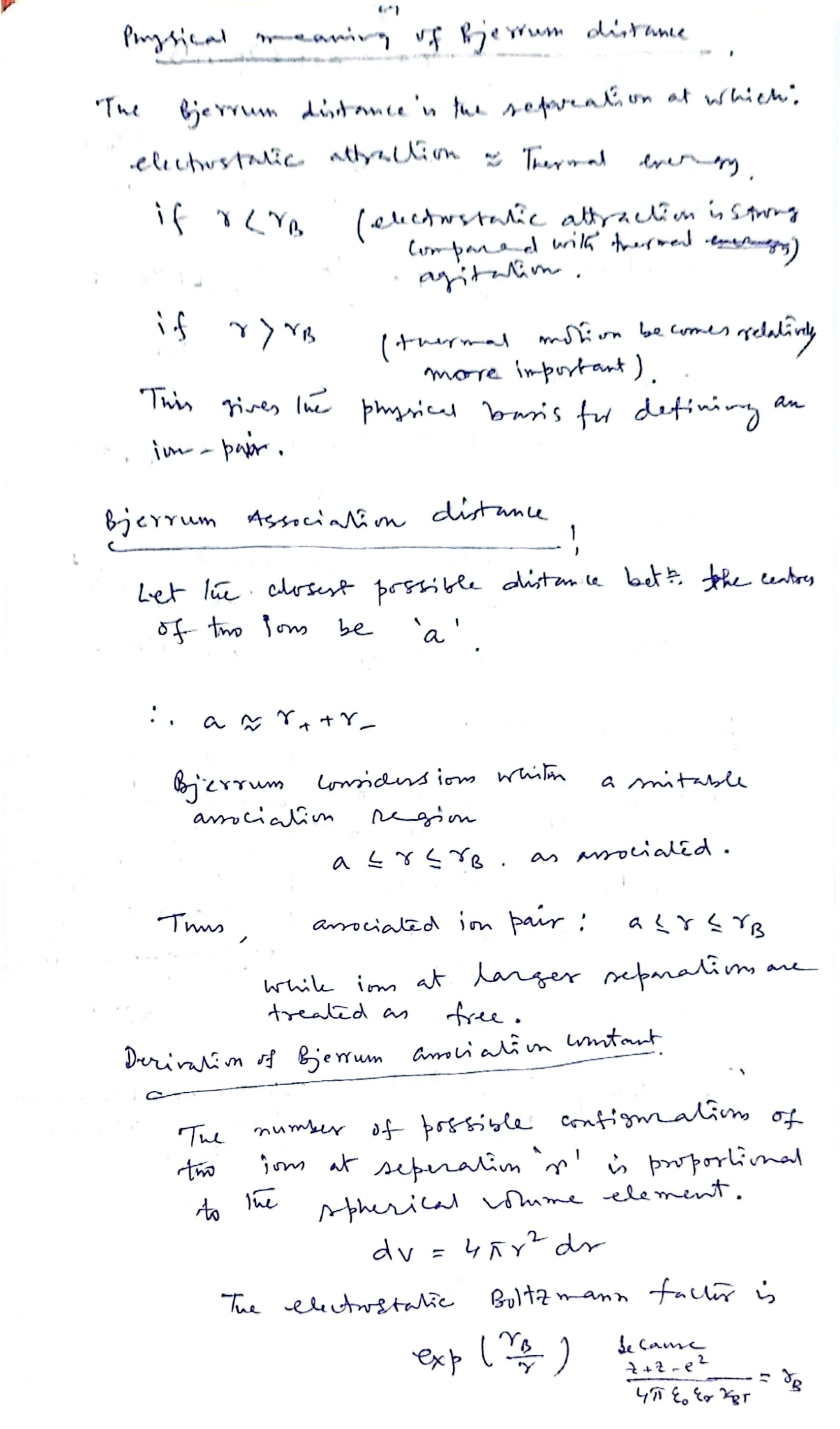
Physical meaning
- : electrostatic attraction is strong compared with thermal agitation → the ions stay together (association, ion pair).
- : thermal motion becomes relatively more important → the ions behave as free ions (dissociation).
This comparison — attraction versus — is the physical basis for defining an ion pair.
How wide is the pairing window?
The green band is the association region $a \le r \le r_B$ drawn to scale. Cool the solution, drop the dielectric constant, or raise the charge product — and watch the window open.
Sanity value: water (ε = 78.5) at 298 K, 1:1 electrolyte → r(B) ≈ 7.1 Å, the textbook number. Wider window = more separations count as associated = larger K(A) (Sections 7–8).
06 The association region: from a to rB
Let the closest possible distance between the centres of the two ions be — the contact distance,
Bjerrum considers ions within a suitable association region as associated:
while ions at larger separations are treated as free. Separations below are simply not possible — the ion cores cannot interpenetrate.
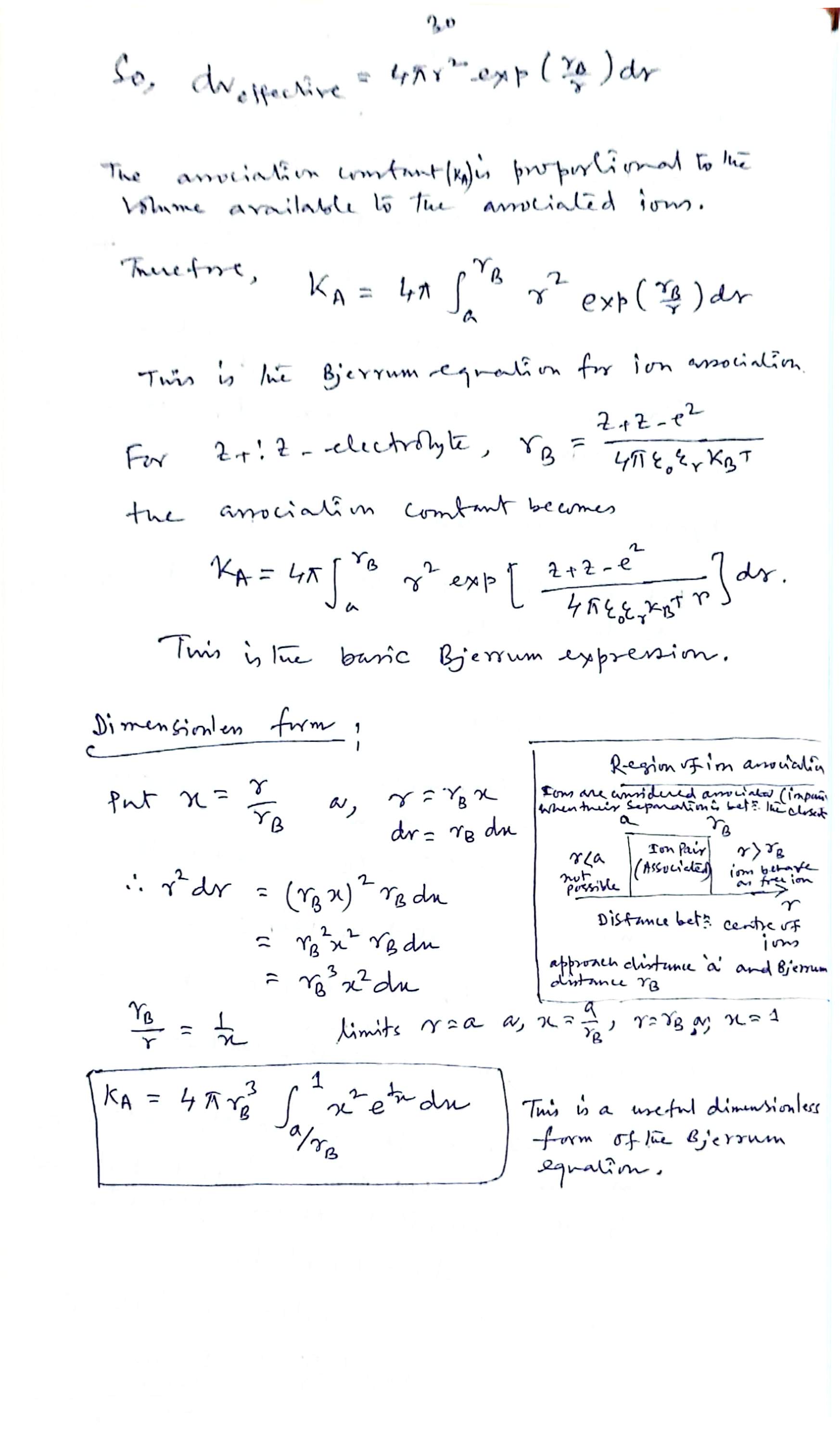
| Separation | Status | Why |
|---|---|---|
| not possible | closest approach is the contact distance | |
| ion pair (associated) | electrostatic attraction > thermal energy | |
| free ions | thermal motion dominates |
Pair or free? Slide the separation
One cation, one anion, water at your chosen temperature. Inside $r_B$ the Coulomb grip wins and the pair jiggles together; outside it, thermal motion pulls them apart into free ions.
|U| ≫ k(B)T (ratio far below −1) means the pair survives thermal kicks; near 0 the ions wander free. Separations below the contact distance a are clamped — the cores cannot interpenetrate (Section 6).
07 Derivation of the Bjerrum association constant
Count the configurations
The number of possible configurations of two ions at separation is proportional to the spherical volume element:
Weight them electrostatically
The electrostatic Boltzmann factor is , because . So the effective weighted shell is
Integrate over the association region
The association constant is proportional to the volume available to the associated ions; therefore
This is the Bjerrum equation for ion association — the basic Bjerrum expression.
08 Dimensionless form of the Bjerrum equation
Put , so and ; then and . The limits become and :
This is a useful dimensionless form of the Bjerrum equation: all the physics of temperature, dielectric constant and charge sits inside , while the integral is a pure number once is fixed.
09 Fraction of ions associated, α
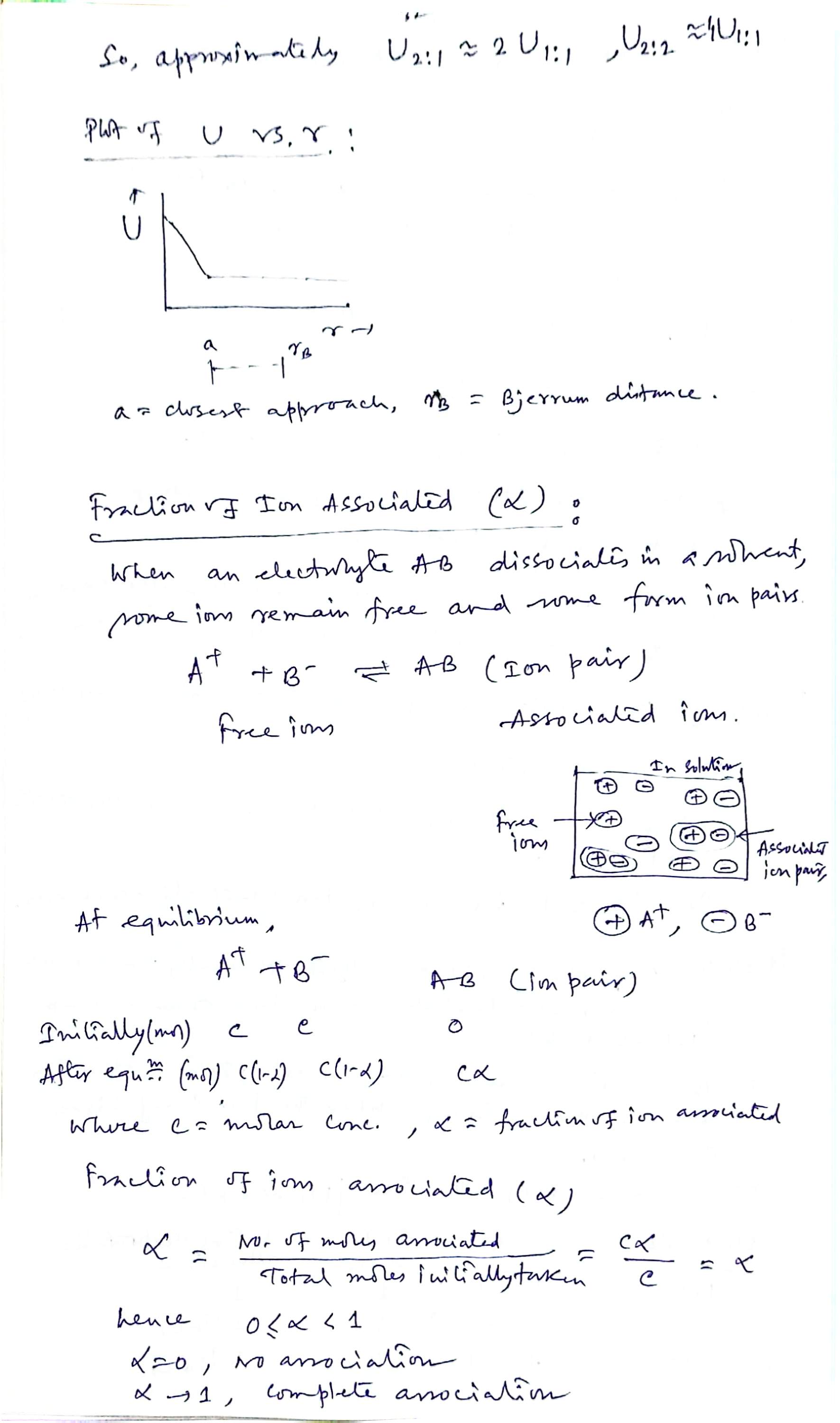
When an electrolyte AB dissociates in a solvent, some ions remain free and some form ion pairs:
At equilibrium, with = molar concentration and = fraction of ions associated:
| (ion pair) | |||
|---|---|---|---|
| Initially (mol) | |||
| After equilibrium (mol) |
The fraction associated is the moles associated over the total moles initially taken:
- : no association — every ion free.
- : complete association — essentially all ions paired.
The complementary quantity is the degree of dissociation:
counts ion pairing; counts free ions. Keep the two labels straight — exams love swapping them.
10 α ↔ K(A), and the connection with conductivity
For the association constant is
Connection with conductivity
For a weakly associated 1:1 electrolyte, only free ions carry current, so
where = molar conductivity at concentration and = limiting molar conductivity. As ion association increases, free ions decrease, and decreases — the conductivity meter is literally counting the ions that escaped pairing.
Association fraction ↔ what the meter reads
Set the association constant and the concentration: the exact quadratic gives α, and the ion pool below re-partitions into free ions and contact pairs. The conductivity ratio is simply Λ(c)/Λ°(c) = 1 − α.
Dilution check: send c → 0 and α → 0 (pairs dissolve, Λ → Λ°). Concentrate or raise K(A) and the pool pairs up while the conductivity ratio falls — exactly the trend of Section 10.
11 Play with the Bjerrum equation
The whole lecture in one panel: Bjerrum distance, the dimensionless integral (numerically integrated live), the association constant, and the paired fraction at your concentration.
Try water (ε = 78.5), 298 K, 1:1, a = 4.0 Å: r(B) ≈ 7.1 Å and K(A) lands in the single-digit L/mol — weak pairing. Switch to 2:2 at the same conditions and K(A) explodes by ~r(B)³ × integral (hundreds–thousands): that is MgSO₄ territory. Reduced ε (dioxane-like) does the same. The integral is Simpson-rule over x ∈ [a/r(B), 1]; α solves K(A) = α / [c(1−α)²] exactly.
12 The equation sheet, at a glance
Every boxed result of the lecture on one screen; labels match the derivation above.
13 Symbol table
| Symbol | Meaning | Typical unit |
|---|---|---|
| Charge numbers of cation and anion | dimensionless | |
| Elementary charge | C | |
| Ion charges, and | C | |
| Separation between ion centres | m, Å | |
| Closest-approach (contact) distance, | m, Å | |
| Bjerrum distance / length: | m, Å (≈ 7.1 Å in water, 298 K, 1:1) | |
| Electrostatic potential energy of the pair (negative = attractive) | J | |
| Vacuum permittivity; relative permittivity of the solvent | F m⁻¹; dimensionless | |
| Boltzmann constant | J K⁻¹ | |
| Absolute temperature | K | |
| Bjerrum association constant | mol⁻¹ L | |
| Dimensionless separation, | dimensionless | |
| Molar concentration of the electrolyte | mol L⁻¹ | |
| Fraction of ions associated (ion pairing), | dimensionless | |
| Degree of dissociation (free-ion fraction), | dimensionless | |
| Molar conductivity at ; limiting molar conductivity | S cm² mol⁻¹ |
14 Rapid revision — 12 lines before the exam
- Ion pair = cation + anion held by Coulomb attraction alone; .
- Bjerrum assumptions: charged points, continuum dielectric, electrostatics only, small = associated, large = free.
- ; negative sign = attractive.
- Boltzmann weight → huge at close approach.
- : where ; ; 1:1 → ≈ 7.1 Å in water at 298 K.
- : attraction wins (pair). : thermal motion wins (free).
- Association region with ; impossible.
- (dimensionless form).
- = fraction associated (); = fraction dissociated.
- , units mol⁻¹ L; conductivity link .
- Association ↑ when: ↓, ↓, ↑. Same three make ↑; dilution makes look ↓ in effect via .
- Charge ladder: 1:1 → ; 2:1 → 2; 2:2 → 4, so (MgSO₄ pairs hard).
15 Original notebook scans
Digitised from the class notebook of 30 Aug 2026 — notebook pages 27–33 (CamScanner spreads S1–S7, the fair copy) plus the in-class phone photos N1–N6; every equation above was cross-checked against these pages. Tap any thumbnail to open the full scan.
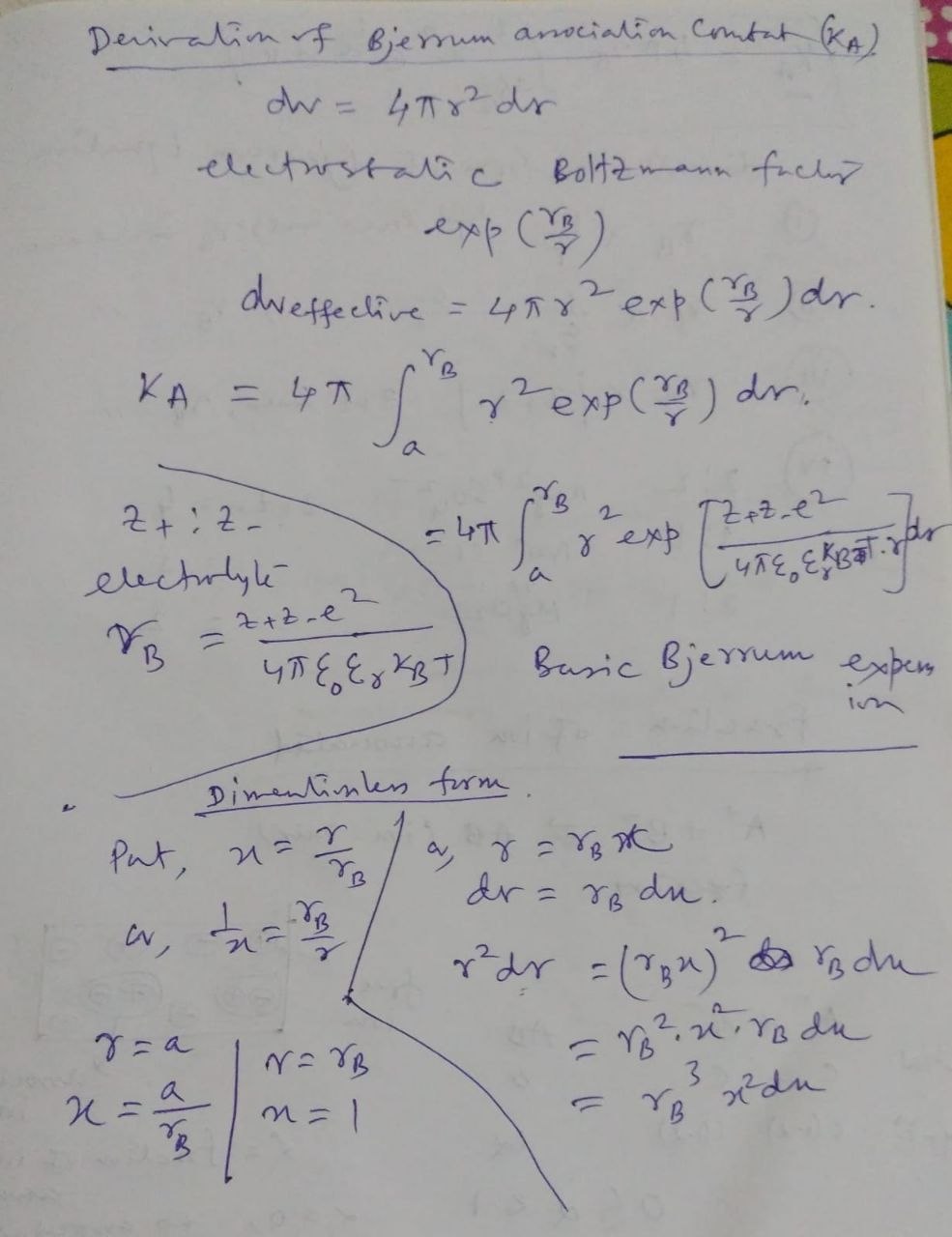 N1 · K(A) derivation + dimensionless form
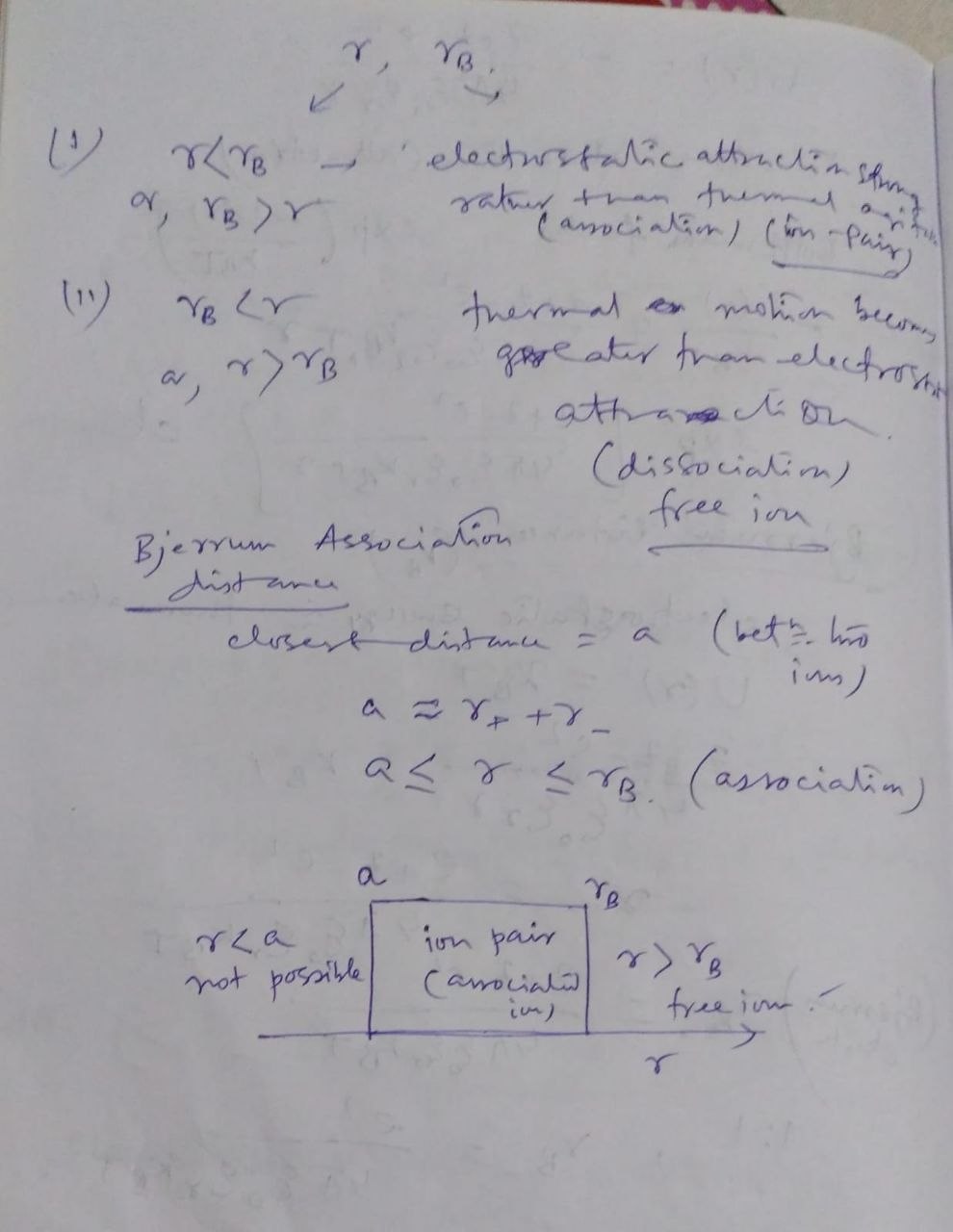 N2 · meaning of rB, region diagram
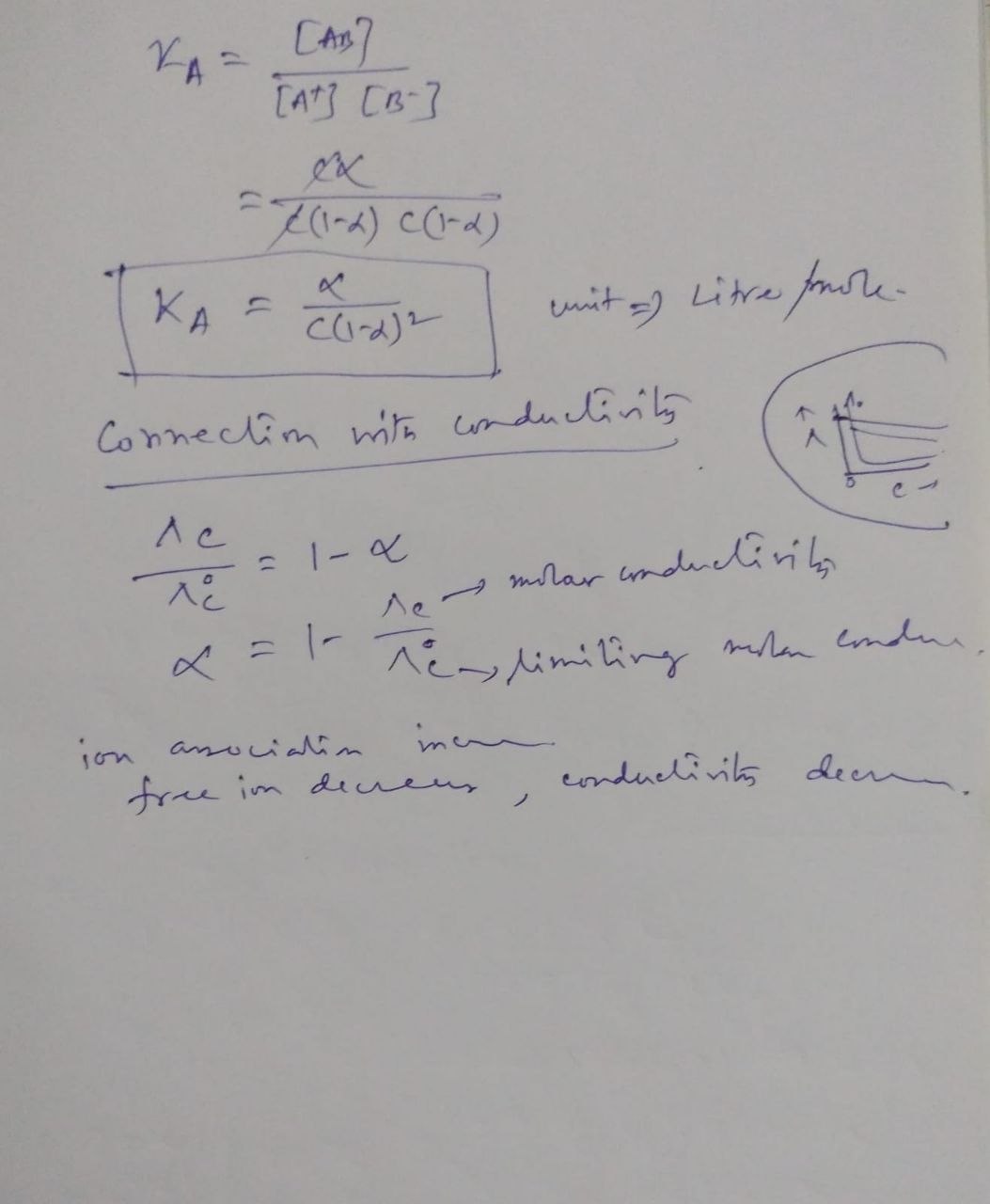 N3 · K(A) = α/c(1−α)², conductivity link
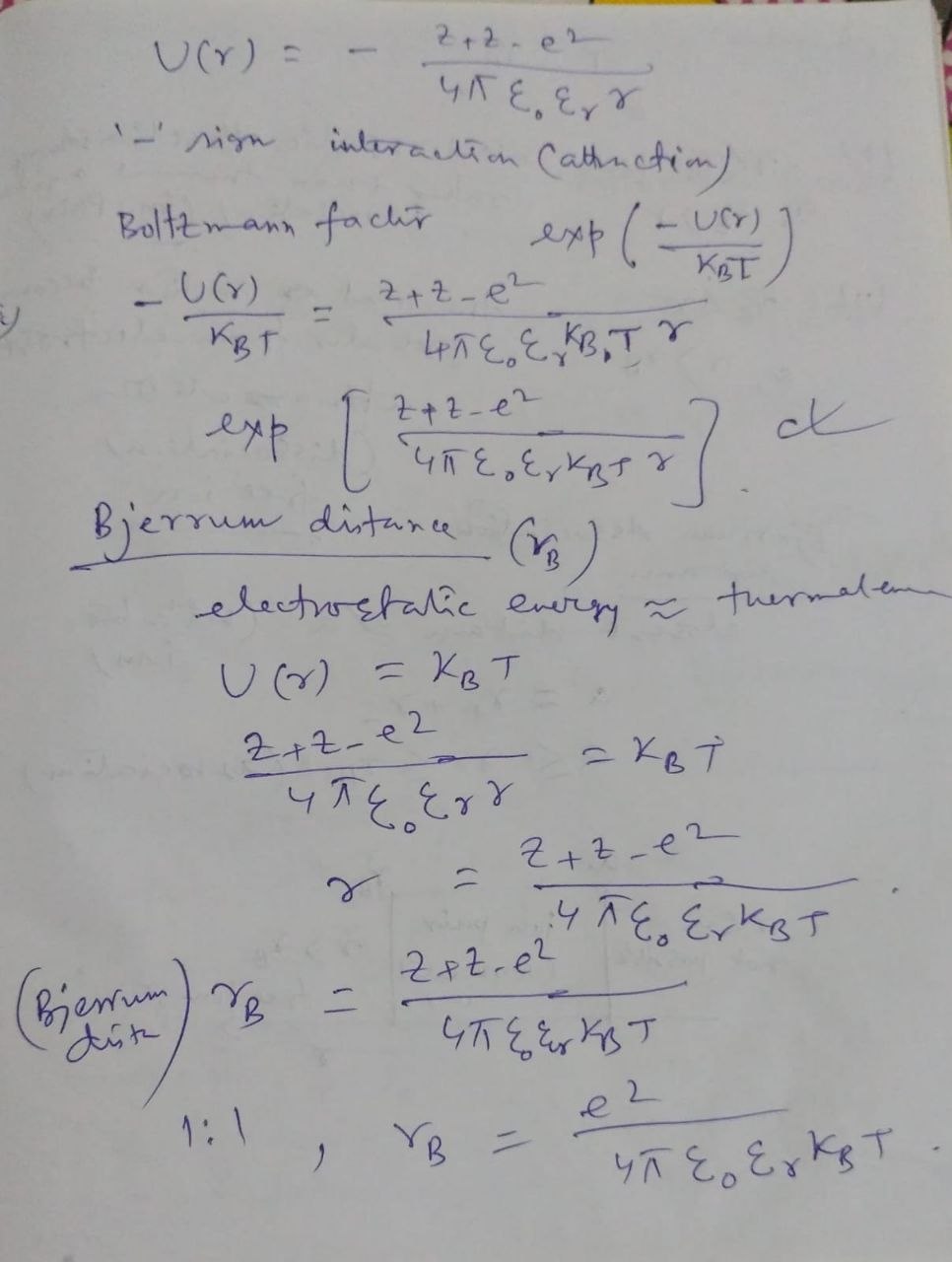 N4 · U(r), Boltzmann factor, rB
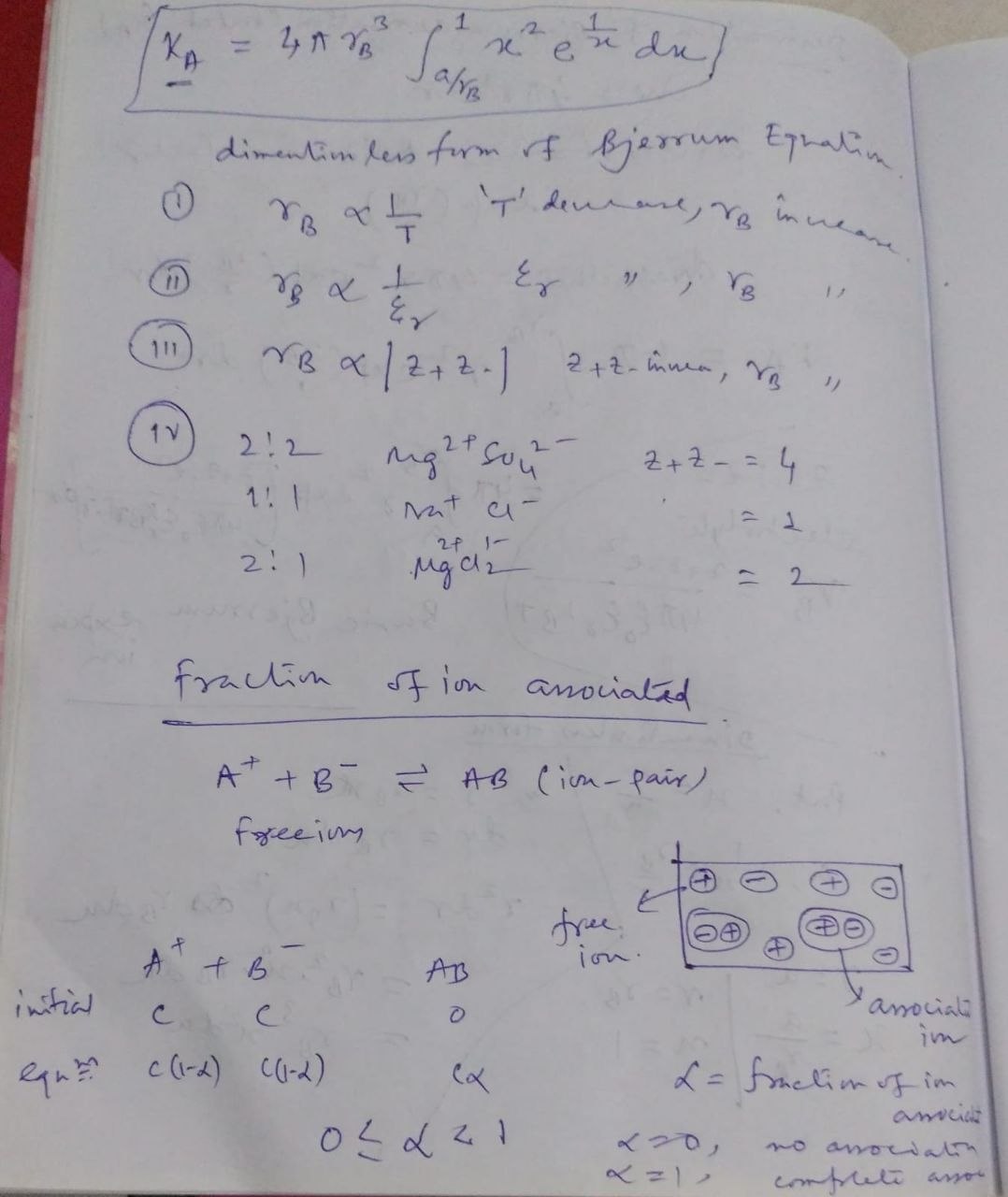 N5 · boxed K(A), trends, α table
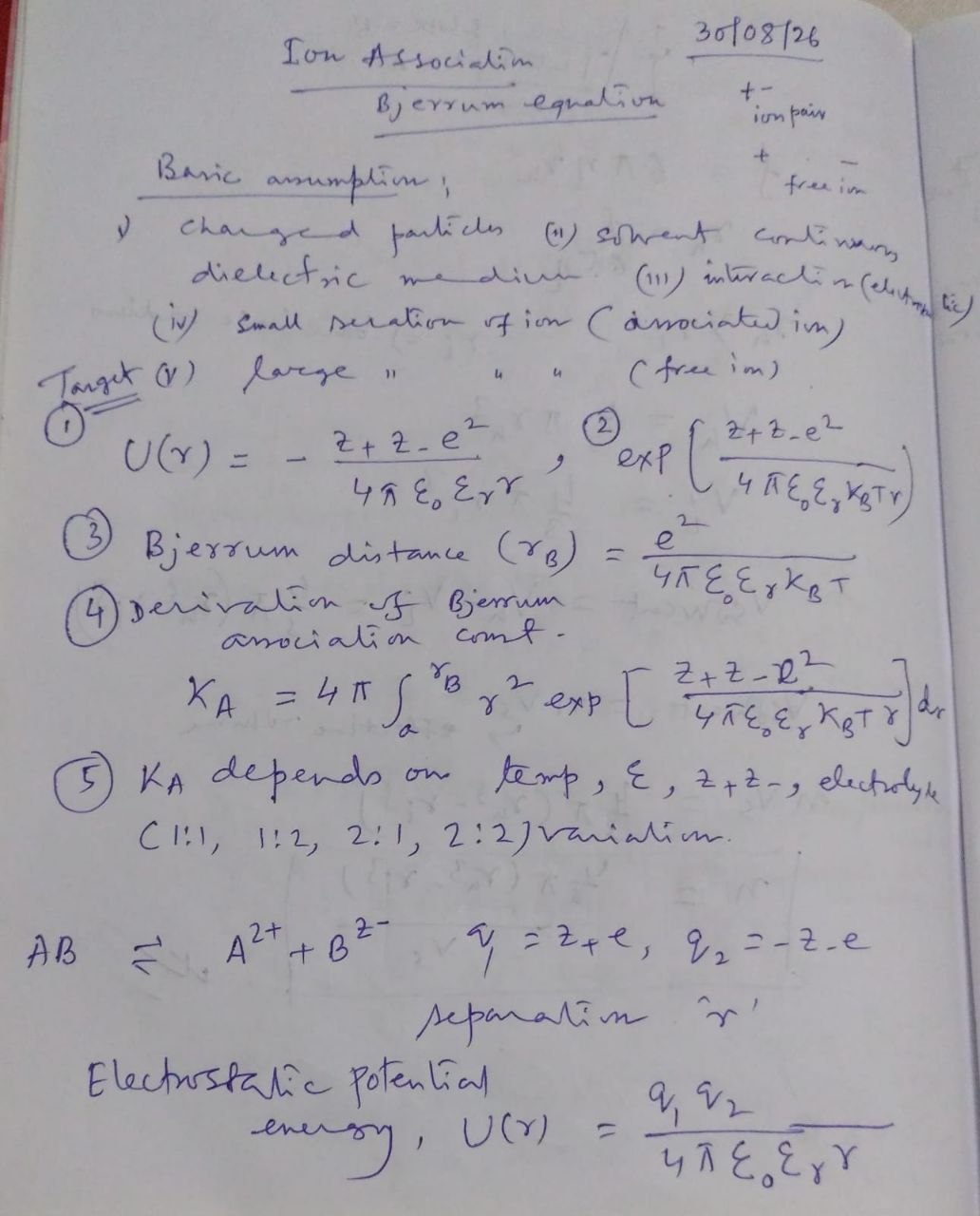 N6 · 30/08/26 header, assumptions, targets
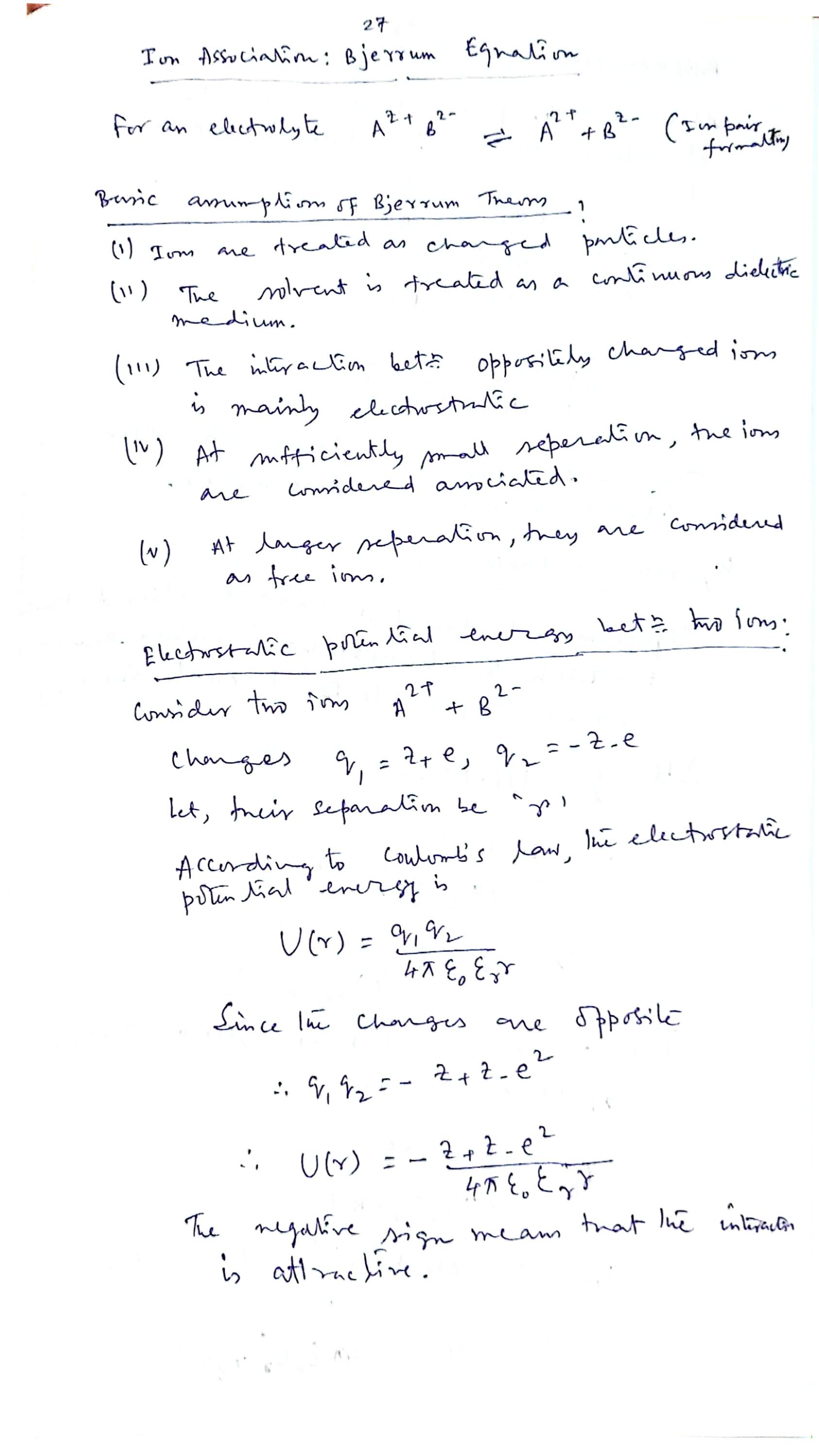 S1 · p27 · assumptions, U(r)
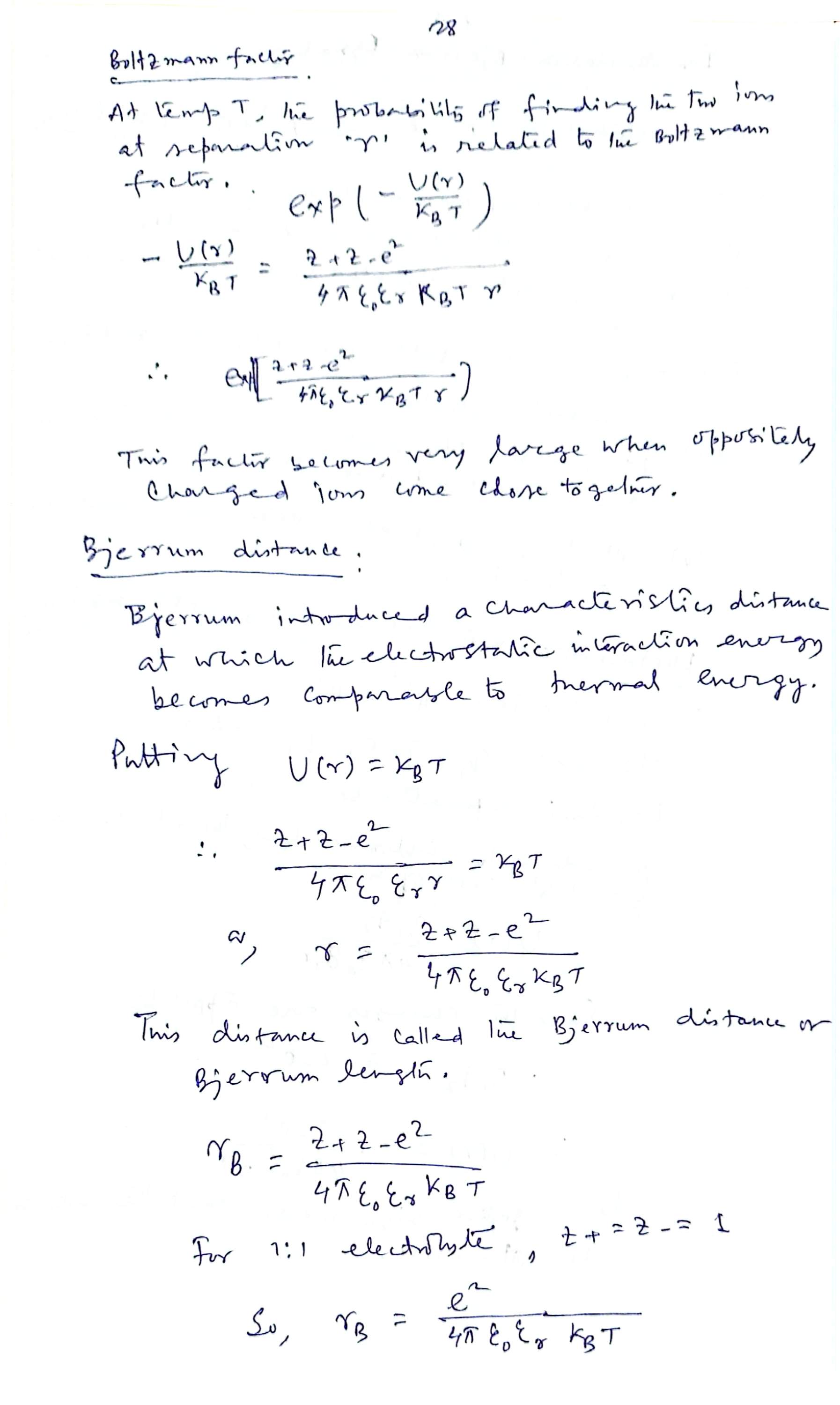 S2 · p28 · Boltzmann factor, rB
 S3 · p29 · meaning, region, derivation start
 S4 · p30 · K(A) integral, dimensionless, region box
 S5 · p31 · Prob 1–4, charge table
 S6 · p32 · U vs r plot, α, ICE table
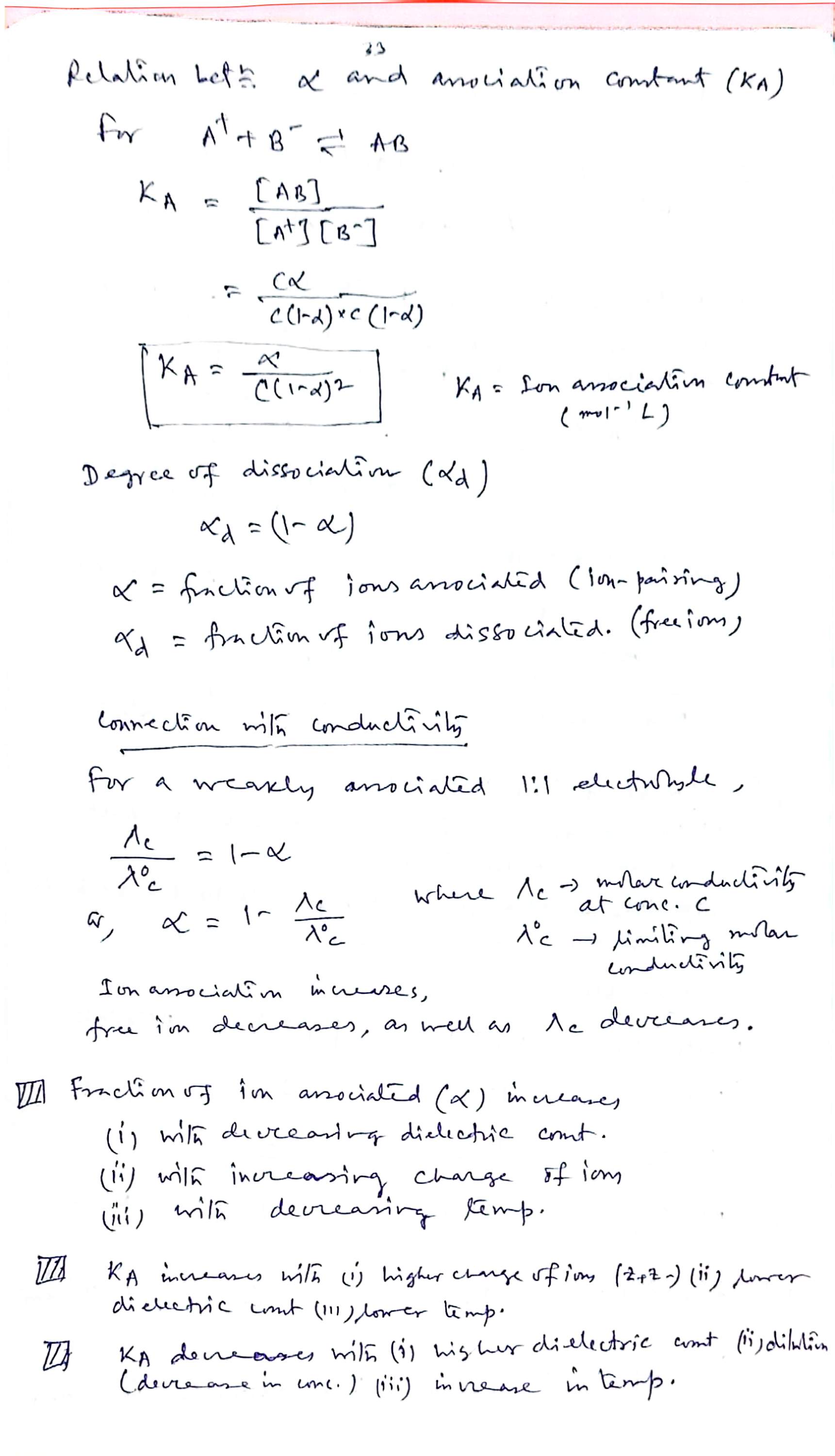 S7 · p33 · K(A)=α/c(1−α)², Λ link, summary
16 PYQ bank · University papers 2020–2024
Same audit as Classes 1–2: every page of the five M.Sc. Semester-I question papers (2020–2024 — all subjects MSCH-101…106, 60 scanned pages) OCR'd and verified by hand; the Physical Chemistry paper each year is MSCH-104 (Physical General-I). The rule is unchanged: only questions that actually appeared, tagged with year and repeat count.
| Year | Physical paper (MSCH-104) | Pages verified | Class-3 questions (ion association / Bjerrum) |
|---|---|---|---|
| 2020 | Physical General I (new + old syllabus copies) | p. 12–15 | 0 — group theory, QM, stat-thermo, rotational/vibrational spectroscopy, fullerenes |
| 2021 | Physical General I (+ internal) | p. 7–8 | 0 — group theory, QM, partition functions, nanotubes, Raman |
| 2022 | Physical General I | p. 9–10 | 0 — symmetry, operators, spectroscopy, stat-thermo |
| 2023 | Physical General I | p. 9–10 | 0 — point groups, operators, rotors, Raman, fullerenes, stat-thermo |
| 2024 | Physical General I | p. 12–13 | 0 — group theory, matrices, rotors, polarizability, partition functions |
Across 2020–2024 the university never asked an ion-association / Bjerrum question in these papers — MSCH-104 in those years is entirely group theory, quantum mechanics, spectroscopy and statistical thermodynamics — so, per the rule, the year-tagged bank stays empty rather than being padded with look-alikes. The moment one appears it lands here with its year and repeat count. For practice, the lecture's own four problems are answered in full below.
Lecture's own problems — answered in full
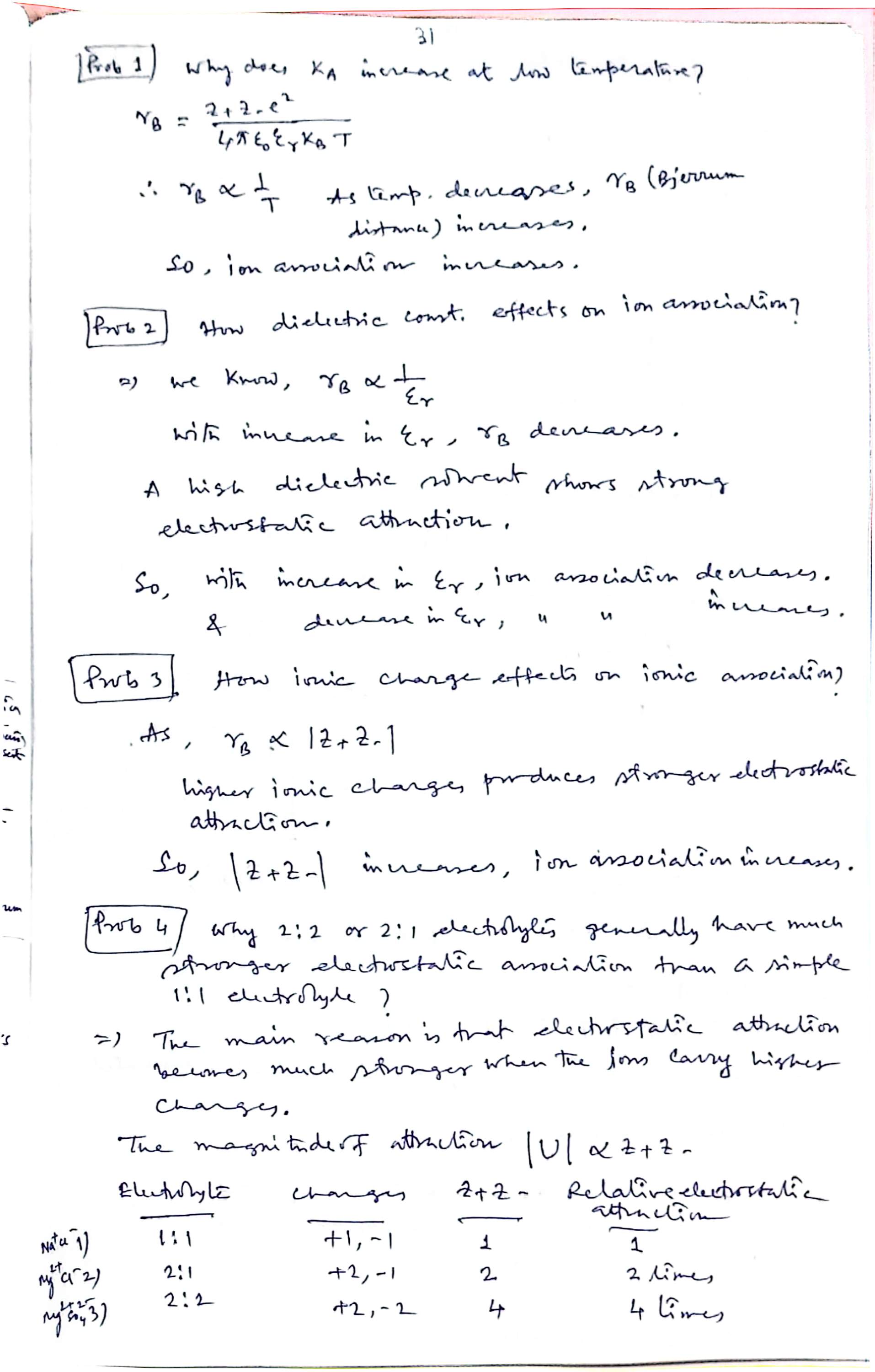
Q. Why does increase at low temperature?
Ans. From we get . As temperature decreases, the Bjerrum distance increases — the attraction-dominated zone widens — so more ion pairs qualify as associated and increases.
Q. How does the dielectric constant affect ion association?
Ans. . With an increase in the Bjerrum distance decreases (the solvent screens the attraction), so ion association decreases; with a decrease in association increases. High-dielectric solvents like water keep ions apart; low-dielectric solvents let them pair.
Q. How does ionic charge affect ion association?
Ans. . Higher ionic charge produces stronger electrostatic attraction, so as increases the Bjerrum distance grows and ion association increases.
Q. Why do 2:2 or 2:1 electrolytes generally have much stronger electrostatic association than a simple 1:1 electrolyte?
Ans. The magnitude of attraction scales as , so higher charge products bind far harder:
| Electrolyte (example) | Charges | Relative electrostatic attraction | |
|---|---|---|---|
| 1:1 (Na⁺Cl⁻) | +1, −1 | 1 | 1 |
| 2:1 (Mg²⁺Cl⁻) | +2, −1 | 2 | 2 times |
| 2:2 (Mg²⁺SO₄²⁻) | +2, −2 | 4 | 4 times |
Hence approximately and — which is why MgSO₄ is the textbook ion-pair former.