§0 Overview
When an ion is dissolved in a polar solvent such as water, strong electrostatic forces exist between the ion and the solvent molecules. These are called ion–solvent interactions (or solvation interactions). This class builds the whole story from that one sentence: what the interaction looks like molecularly, why it is always energetically welcome, and how Born's continuum-electrostatics model quantifies it in a single equation.
Solutions & dissociation of electrolytes · ion–dipole forces & partial charges · hydration / methanolation / solvation · the five assumptions of the Born model · the charging-process derivation of the Born equation · interpretation (charge, radius, dielectric constant) · temperature dependence → entropy & enthalpy of solvation.
Ion–solvent interaction is central to: (i) solubility of electrolytes, (ii) stability of ions in solution, (iii) conductance, (iv) electrochemical reactions, and (v) thermodynamic properties of solutions.
§1 Ion–solvent interaction: the molecular picture
A solution is simply solvent + solute: . In water the electrolyte dissociates,
Water is a polar molecule: oxygen hogs electron density and carries a partial negative charge , while the hydrogens carry partial positive charges . Each freed ion therefore becomes a centre around which solvent dipoles line up — an ion–dipole interaction:
- The oxygen end () of water points toward cations.
- The hydrogen end () points toward anions.
- Rule behind both: like charges repel, opposite charges attract.
This orderly lining-up of dipoles is exactly what the Born model later replaces by a single number — the dielectric constant . Keep the picture in mind; the mathematics is just this picture, averaged.
§2 Hydration, methanolation, solvation
The interaction is named after the solvent doing the surrounding:
| Solvent | Term | Example |
|---|---|---|
| Water | Hydration | Na⁺ wrapped by six H₂O through their O ends |
| Methanol | Methanolation | ions dissolved in CH₃OH |
| Any solvent (general) | Solvation | ion + solvent → solvated ion |
§3 The Born model (1920) & its assumptions
The Born model (1920) is the simplest electrostatic theory of ion–solvent interaction. It replaces the molecular picture above with pure continuum electrostatics:
- The ion is treated as a rigid spherical charge of radius carrying charge .
- The ion is initially in vacuum, where the relative permittivity is .
- It is then transferred into the solvent, a continuous dielectric medium of relative permittivity (the dielectric constant).
- The dielectric constant of the solvent is uniform everywhere — even next to the ion.
- No specific chemical bonding occurs between ion and solvent; only electrostatic interaction is considered.
Real solvents are molecules, not a continuum; right next to an ion is not the bulk value (dielectric saturation), and ion–solvent bonds do exist. Born's genius was that even this crude picture captures the dominant, electrostatic part of solvation.
§4 Physical concept & solvation energy
When an ion moves from vacuum into a solvent: (i) polar solvent molecules orient around the ion, and (ii) electrostatic attraction lowers its energy. Hence solvation is energetically favourable:
The energy change when one mole of gaseous ions is transferred from the gas phase into a solvent to form solvated ions:
It measures the strength of ion–solvent interaction, and it is generally negative because the interaction stabilises the ion.
§5 The charging derivation, step by step
Born's trick: charge the sphere gradually while it sits in the medium. The work to bring an infinitesimal charge onto a sphere already at potential is . Integrate from to the full ionic charge .
Charging work element
is the potential at the surface of the sphere.
Potential of a sphere in a medium of permittivity ε
Combine (i) and (ii)
Integrate the charging from 0 → ze
Using — this is the electrostatic self-energy of the ion in that medium.
Energy of the ion in vacuum (εᵣ = 1)
Energy of the ion in solvent (εᵣ = ε)
Free energy of transfer = solvation
Born equation (single ion), then per mole (× Nₐ)
where = Avogadro number, = ionic charge, = electronic charge, = ionic radius, = permittivity of vacuum, = dielectric constant of the solvent.
Bundle the constants into :
Since for every real solvent, the bracket is positive and — solvation is spontaneous, thermodynamically favourable.
§6 Reading the equation: three effects
(i) Ionic charge
Higher ionic charge → larger negative ΔG → stronger solvation. Double the charge and the magnitude quadruples: .
(ii) Ionic radius
Smaller ion → higher charge density → more negative ΔG → greater solvation energy. As decreases, increases.
(iii) Dielectric constant
As , and the bracket , so . High-ε solvents stabilise ions best.
§7 Temperature dependence: ΔS and ΔH of solvation
Only one quantity in the Born equation really depends on temperature: the dielectric constant . Everything else follows from standard thermodynamics.
From we get , hence for any process at constant pressure,
Differentiate the Born equation with as a temperature-independent constant, i.e. . The only T-dependent piece:
(chain rule: ). Substituting into (a):
For most solvents the dielectric constant falls as temperature rises, — thermal motion fights dipole alignment. Therefore is negative: solvation increases the ordering of solvent molecules around the ion (exactly the oriented shells of Fig 1–3).
Finally the enthalpy, from :
Because , the term partially cancels the first bracket, yet for typical solvents the whole expression stays negative: — solvation is exothermic in nature.
§8 The Born equation, at a glance
The notebook's closing summary — "Born equation solution" — with all three functions filled in:
§9 Symbol table
| Symbol | Meaning | Value / units |
|---|---|---|
| z | ionic charge number | dimensionless (1, 2, 3…) |
| e | electronic charge | 1.602 × 10⁻¹⁹ C |
| Nₐ | Avogadro number | 6.022 × 10²³ mol⁻¹ |
| ε₀ | permittivity of vacuum | 8.854 × 10⁻¹² F m⁻¹ |
| ε | dielectric constant of solvent (relative permittivity) | water ≈ 78.5, methanol ≈ 32.7, hexane ≈ 2 (25 °C) |
| r | ionic radius (Born treats the ion as a rigid sphere) | m (often quoted in pm) |
| T, p | temperature, pressure (derivatives taken at constant p) | K, bar |
| (∂ε/∂T)ₚ | temperature coefficient of the dielectric constant | < 0 for most solvents (water ≈ −0.36 K⁻¹) |
| ΔG, ΔH, ΔS | Gibbs energy, enthalpy, entropy of solvation (per mole of ions) | J mol⁻¹, J mol⁻¹, J K⁻¹ mol⁻¹ |
§10 Play with the Born equation
Equation (ix), live. Pick an ion and a solvent, watch ΔGsolv respond — and for water, the entropy & enthalpy too (using (∂ε/∂T)p ≈ −0.36 K⁻¹).
Try r = 102 pm, z = +1, water: you should recover the reference values ΔG ≈ −672.3 kJ mol⁻¹, ΔS ≈ −39.8 J K⁻¹ mol⁻¹, ΔH ≈ −684.2 kJ mol⁻¹. Born's continuum model is deliberately crude — real single-ion values deviate (dielectric saturation near small, highly charged ions). Use it to feel the z², 1/r and ε trends, not to quote lab-grade numbers.
§13 PYQ bank · University papers 2020–2024
Every page of the five M.Sc. Semester-I question papers (2020, 2021, 2022, 2023, 2024 — all subjects MSCH-101…106, 60 scanned pages) was OCR'd and verified by hand. The Physical Chemistry paper each year is MSCH-104 (Physical General-I). The rule for this bank is strict: only questions that actually appeared, tagged with year and repeat count.
| Year | Physical paper (MSCH-104) | Pages verified | Class-1 questions (Born / ion–solvent) |
|---|---|---|---|
| 2020 | Physical General I (new + old syllabus copies) | p. 12–15 | 0 — group theory, QM, stat-thermo, rotational/vibrational spectroscopy, fullerenes |
| 2021 | Physical General I (+ internal) | p. 7–8 | 0 — group theory, QM, partition functions, nanotubes, Raman |
| 2022 | Physical General I | p. 9–10 | 0 — symmetry, operators, spectroscopy, stat-thermo |
| 2023 | Physical General I | p. 9–10 | 0 — point groups, operators, rotors, Raman, fullerenes, stat-thermo |
| 2024 | Physical General I | p. 12–13 | 0 — group theory, matrices, rotors, polarizability, partition functions |
Across 2020–2024 the university never asked a direct ion–solvent / Born-model question in these papers — so, per the rule, the year-tagged bank stays empty rather than being padded with look-alikes. The moment one appears in a future paper it lands here with its year and repeat count. For practice, the exam-guide questions below (from the typeset reference study note) are the closest realistic equivalents — each solved in full.
Model exam questions (reference study note) — fully solved
Q. Why is the solvation entropy of an ion in water always negative?
Ans. Differentiating the Born equation at constant pressure gives
Every factor before the derivative is positive, while water's dielectric constant falls as temperature rises — thermal agitation disorders the dipoles — so (≈ −0.36 K⁻¹ at 298 K). Hence . Physically this is the intense spatial ordering and lock-in of water dipoles in the primary hydration shell around the ion.
Q. How does the Born model explain why NaCl is soluble in water (ε = 78.5) but insoluble in hexane (ε = 2.0)?
Ans. The Born free energy carries the factor :
- Water: → ≈ 99% of the maximum electrostatic stabilisation — enough that , so the crystal dissolves.
- Hexane: → only half the stabilisation — insufficient to pay the lattice energy, so the salt stays undissolved.
Q. Calculate for Na⁺ in water at T = 298 K, given r = 1.02 Å, z = +1, ε = 78.5, , e = 1.602 × 10⁻¹⁹ C, Nₐ = 6.022 × 10²³ mol⁻¹, ε₀ = 8.854 × 10⁻¹² F m⁻¹.
Step 1 — Gibbs energy (molar Born equation):
Step 2 — Entropy:
Step 3 — Enthalpy (Gibbs–Helmholtz):
All three negative: solvation of Na⁺ is spontaneous, ordering, and exothermic — exactly the signature derived in §7. (Sanity-check these numbers live in the §10 calculator with r = 102 pm.)
§14 Beyond the Born model — reference cross-check
Extra material from the typeset reference note ("Thermodynamics of Ion–Solvent Interactions, Born Model Notebook v2"): where the continuum picture fails, and by how much.
- Dielectric saturation: within fields of 10⁶–10⁷ V cm⁻¹ of the ion, dipoles are fully aligned and the local permittivity collapses from ε = 78.5 to εlocal ≈ 2–6 — assuming bulk ε up to the ion surface is why Born overestimates |ΔG|.
- Cavity vs crystal radius: in solution the ion carves a physical cavity; the empirical fix is reff = rcryst + δ with δ ≈ 0.85 Å for cations and ≈ 0.10 Å for anions (Latimer–Pitzer–Slansky type correction).
- Cation–anion asymmetry: isoelectronic ions of equal crystal radius (Na⁺ vs F⁻) hydrate differently because water points its O end at cations but its H end at anions.
- Two-layer models: Lee–Evans-style treatments split the solvent into a saturated primary shell (ε₁ ≈ 2–6) and bulk (ε₂ = 78.5), recovering near-experimental thermodynamics.
| Ion | Crystal radius (Å) | Born ΔG (kJ mol⁻¹) | Experimental ΔG (kJ mol⁻¹) | Discrepancy |
|---|---|---|---|---|
| Li⁺ | 0.76 | −892 | −475 | +87.8% (overestimate) |
| Na⁺ | 1.02 | −665 | −365 | +82.2% (overestimate) |
| K⁺ | 1.38 | −491 | −295 | +66.4% (overestimate) |
| F⁻ | 1.33 | −510 | −465 | +9.7% (fair agreement) |
It is the only closed-form model that gets the trends (z², 1/r, ε) and the signs (ΔG < 0, ΔH < 0, ΔS < 0) right from pure electrostatics — every modern continuum solvation model (PCM and descendants) is its sophisticated grandchild.
§11 Rapid revision — 12 lines before the exam
- Ion + polar solvent → ion–dipole interaction; O end (δ⁻) → cation, H end (δ⁺) → anion.
- Water → hydration; methanol → methanolation; general → solvation.
- Born model (1920): rigid spherical charge in a uniform, continuous dielectric; no chemical bonding, electrostatics only.
- Charging work with gives self-energy .
- → the Born equation, always negative for ε > 1.
- Charge effect: ΔG ∝ −z² (double charge → 4× magnitude). Mg²⁺ > Na⁺, Al³⁺ > Mg²⁺.
- Radius effect: ΔG ∝ −1/r (smaller ion → stronger solvation). Li⁺ > Na⁺ > K⁺.
- Dielectric effect: ε ↑ → (1 − 1/ε) → 1 → maximum stabilisation; water ≫ hexane.
- → proportional to (∂ε/∂T)ₚ → negative → solvent becomes ordered around the ion.
- → bracket form with −(T/ε²)(∂ε/∂T)ₚ → exothermic.
- Energy ordering: E(vacuum) > E(solvent); solvation stabilises the ion.
- Solvation energy = energy change when 1 mole of gaseous ions enters the solvent: M⁺(g) → M⁺(solv).
§12 Original notebook scans
Digitised from the class notebook of 16 Aug 2026 (photos N1–N5) and the CamScanner PDF of the same lecture (spreads S1–S4, two notebook pages each); every equation above was cross-checked against these pages. Tap any thumbnail to open the full scan.
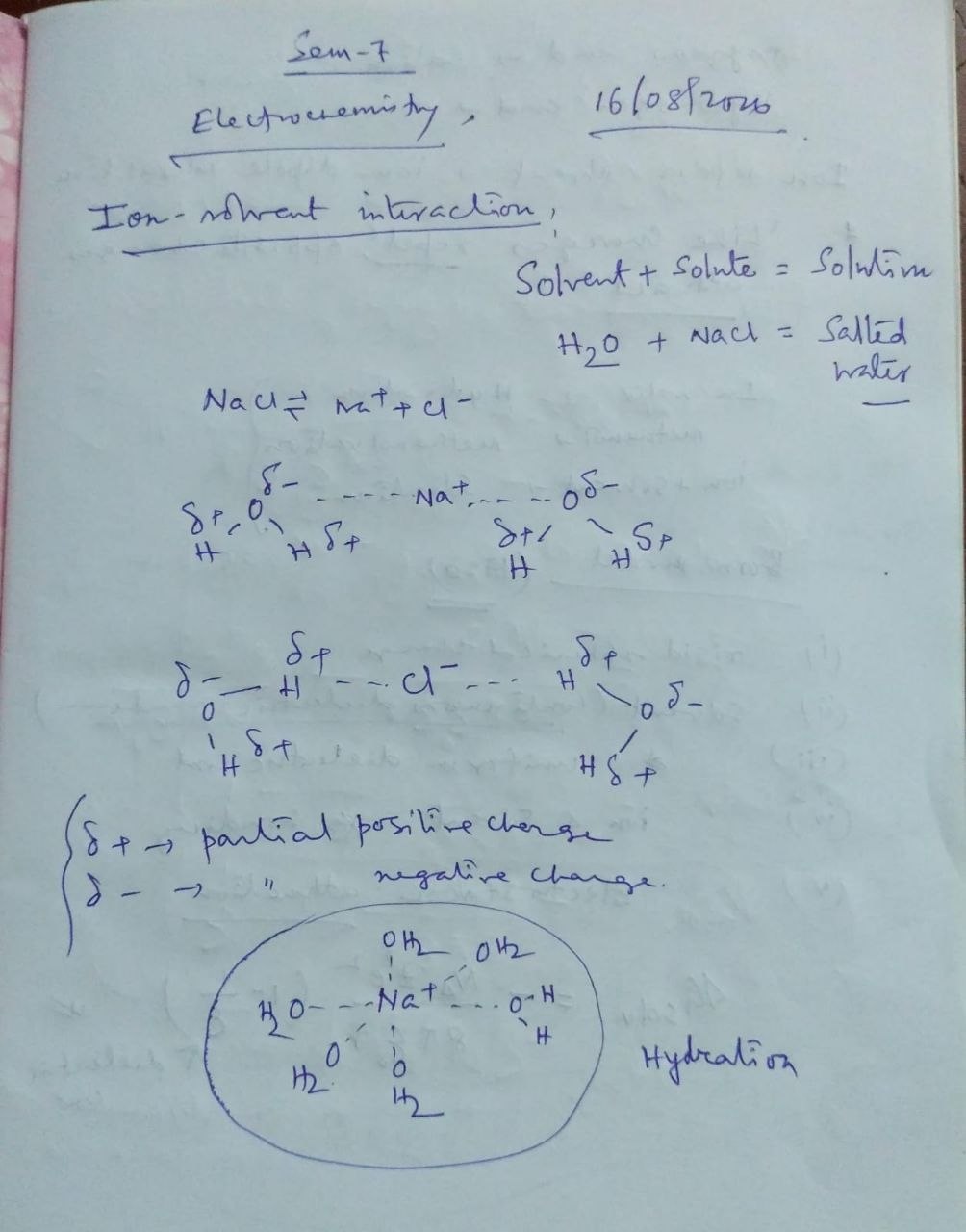 N1 · title & NaCl ⇌ Na⁺ + Cl⁻
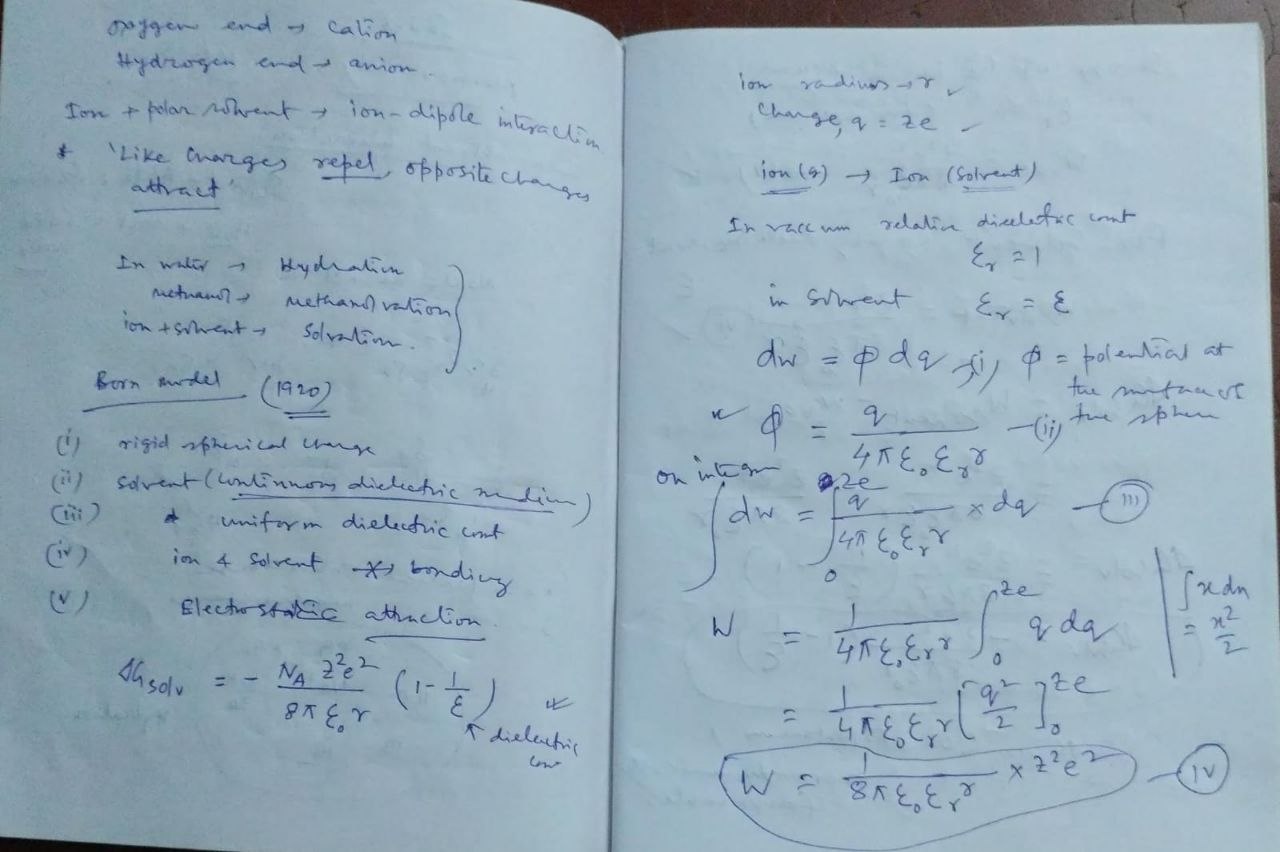 N2 · dipole orientation, Born assumptions
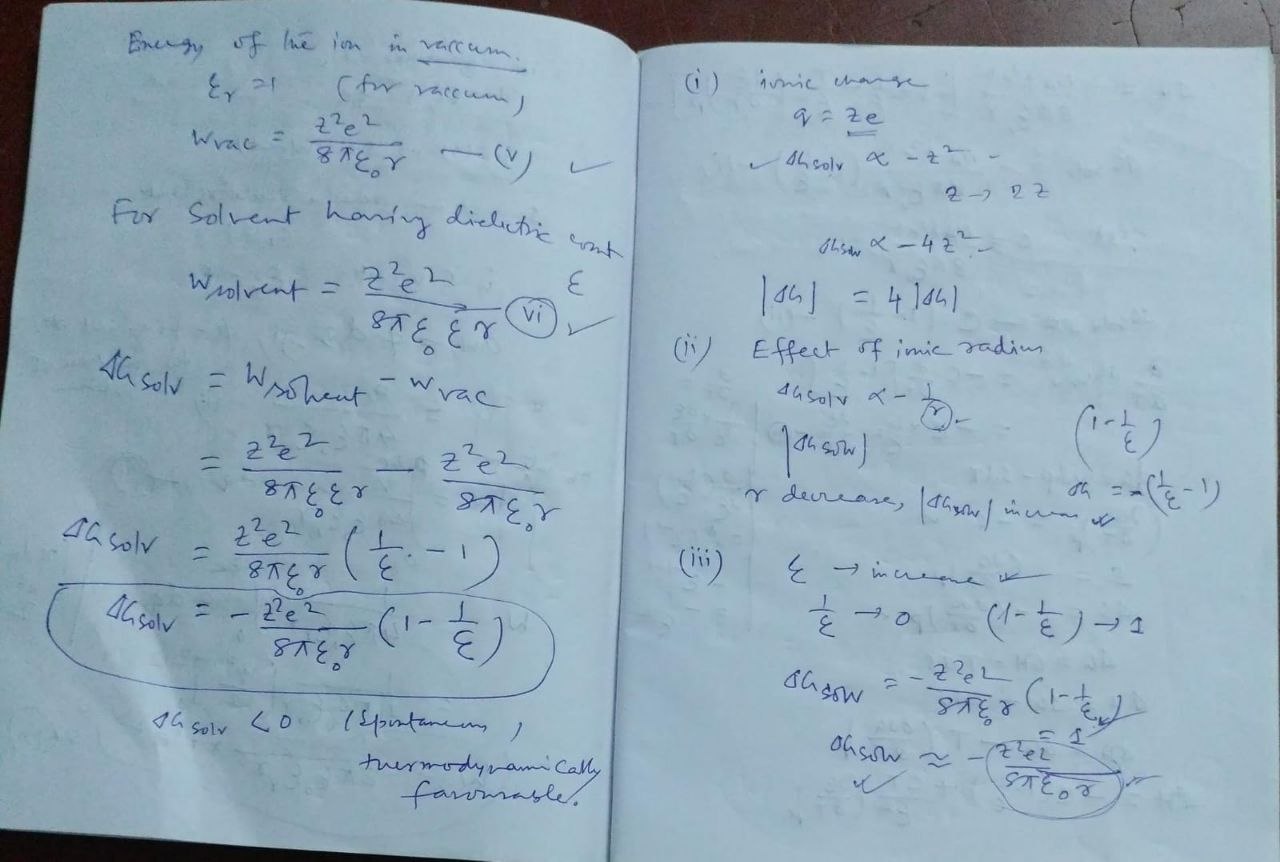 N3 · W(vac), W(solv), boxed ΔG
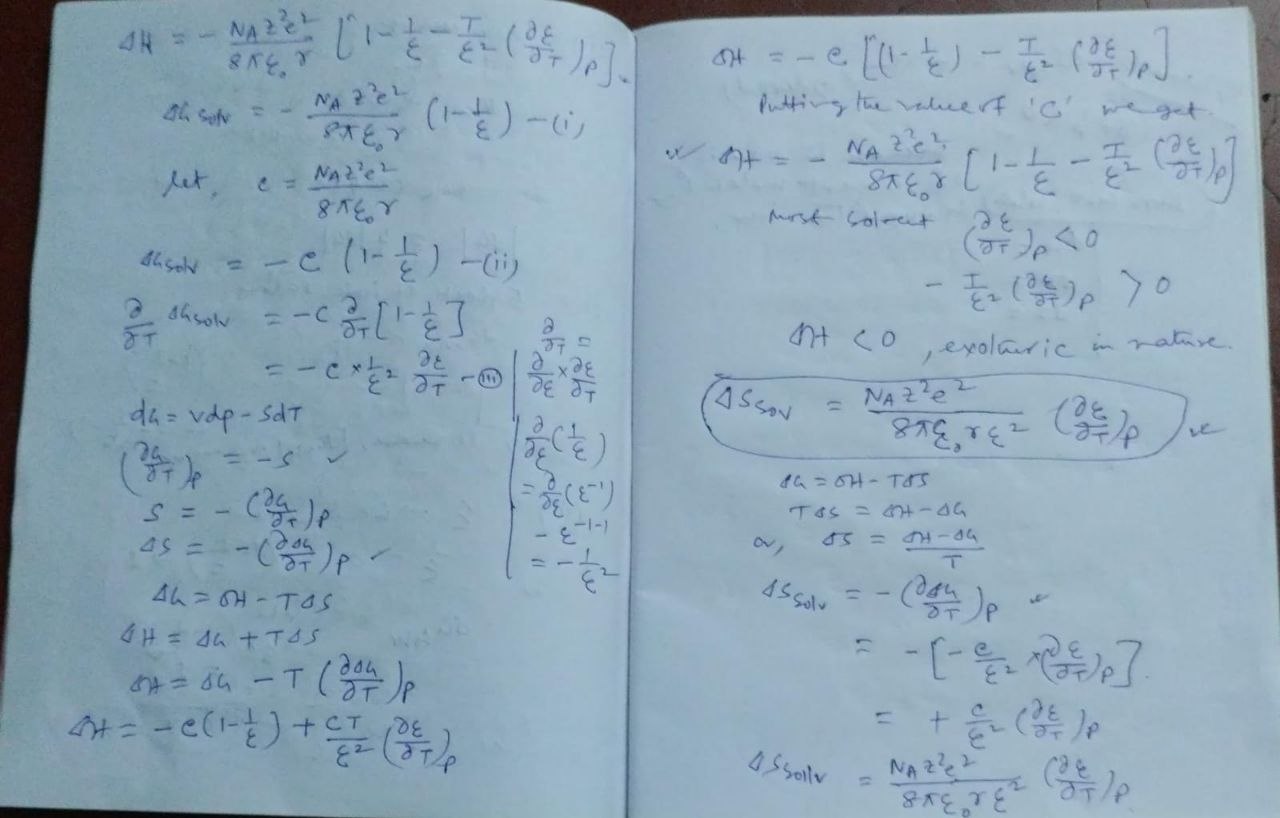 N4 · ΔH & ΔS derivation
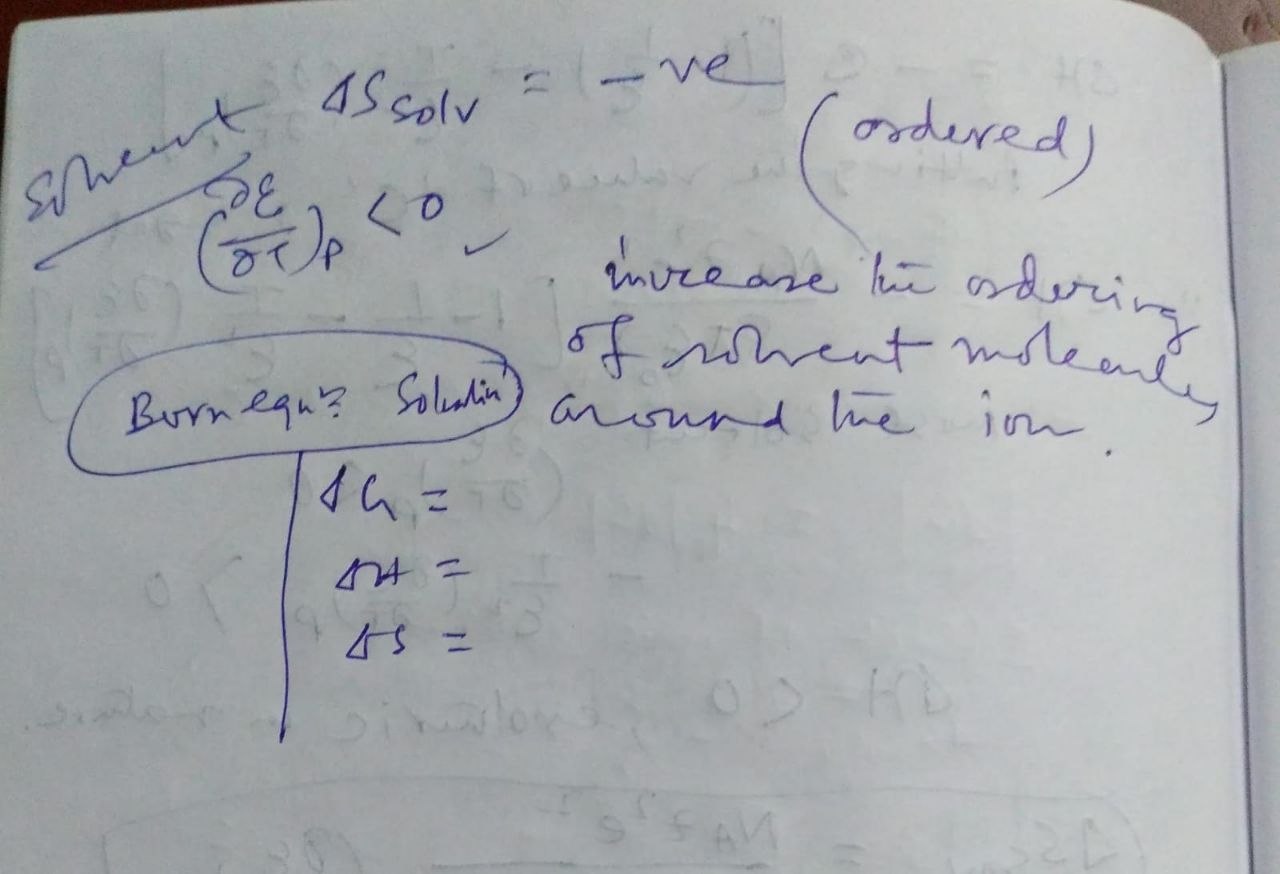 N5 · ΔS < 0, ordering; summary
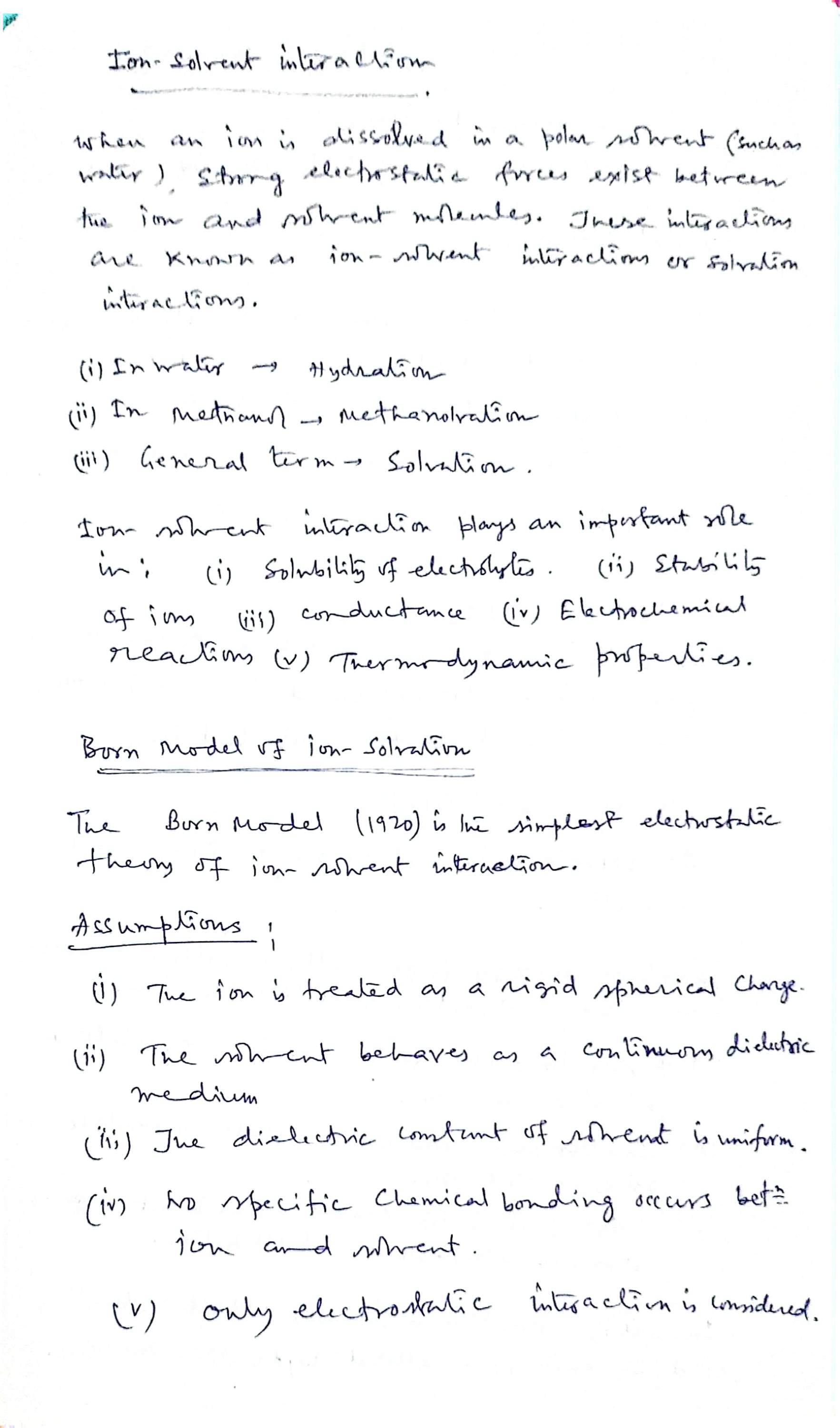 S1 · interaction, terms, importance
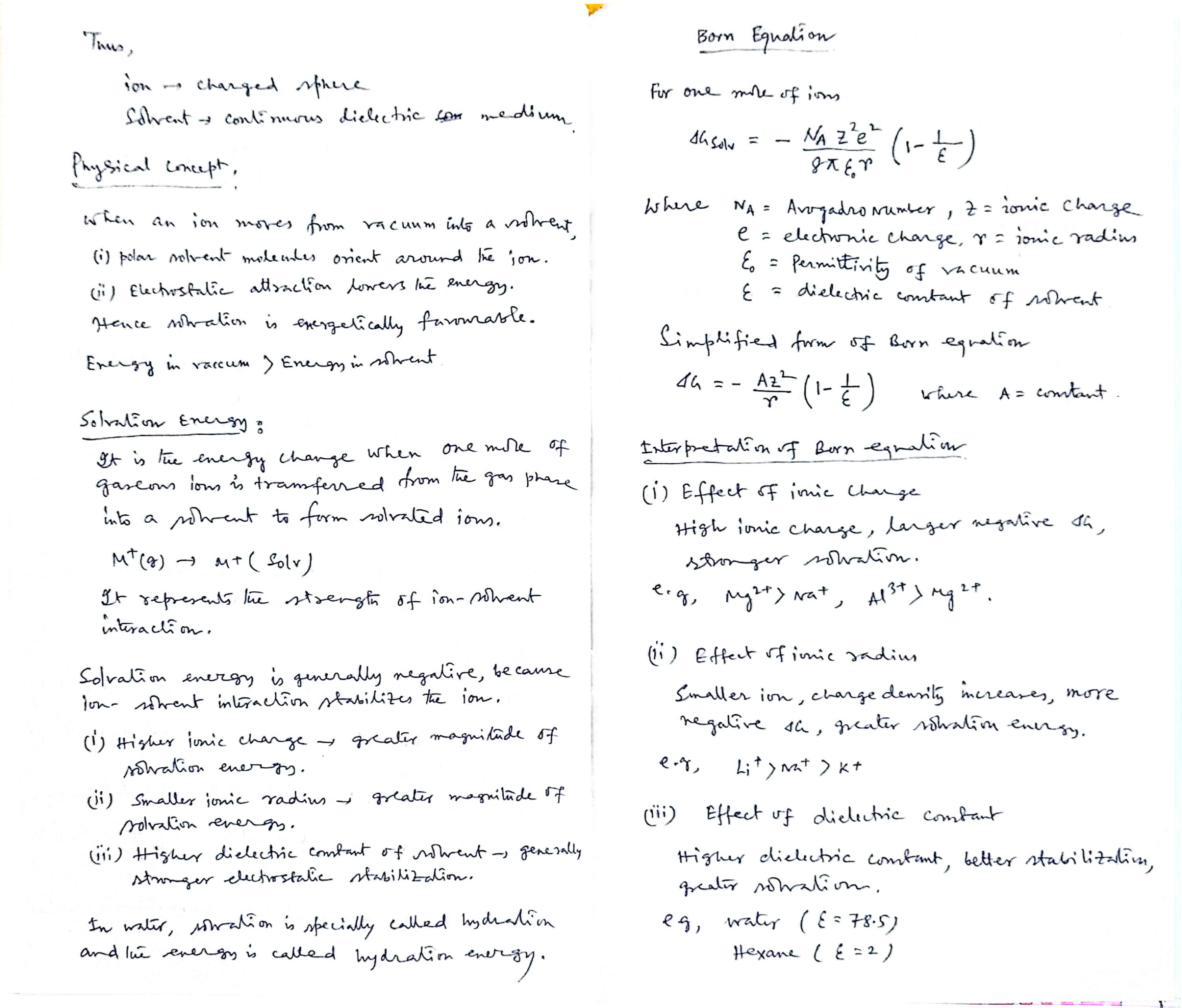 S2 · concept, solvation energy, Born eqn
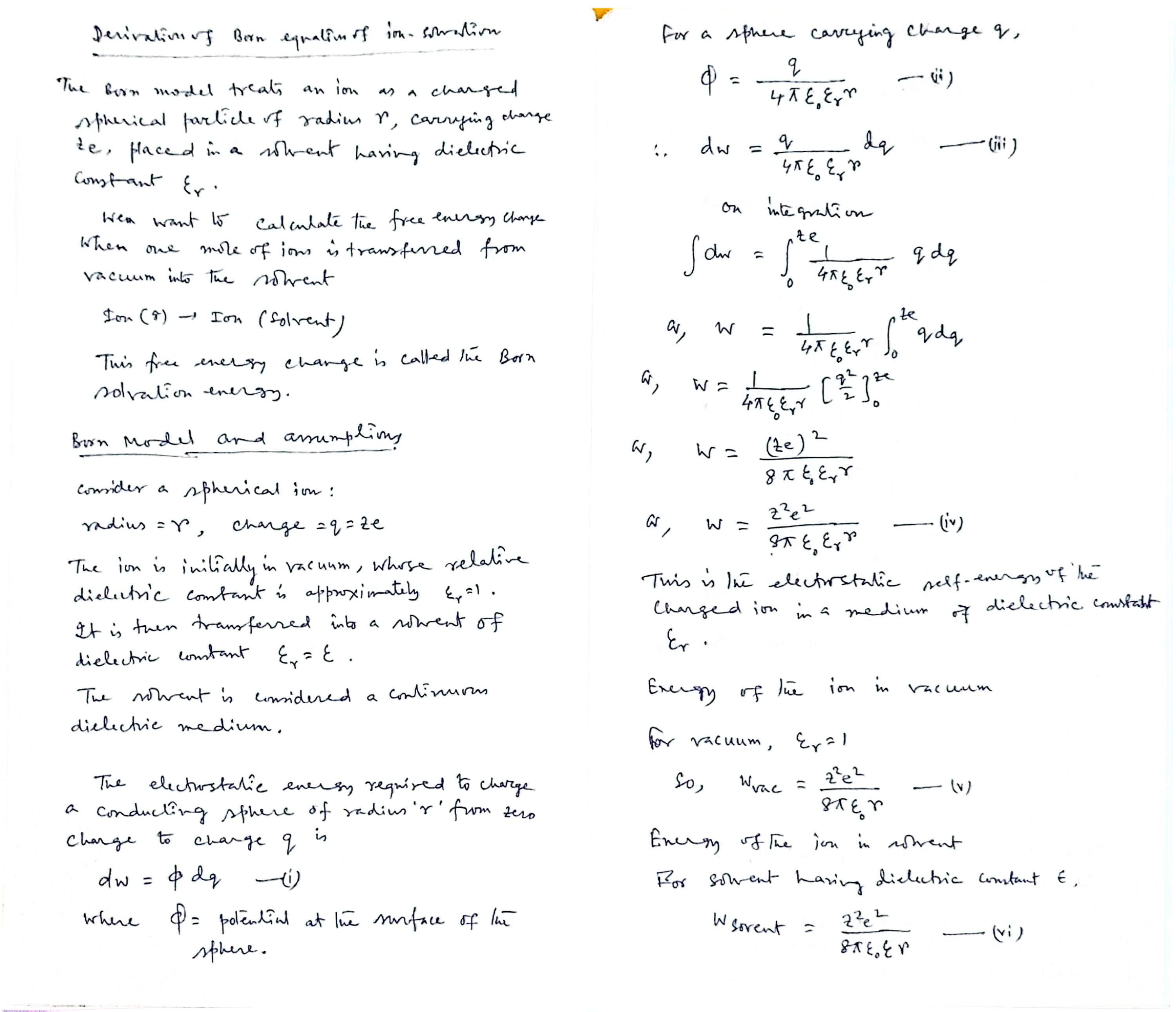 S3 · charging derivation (i)–(vi)
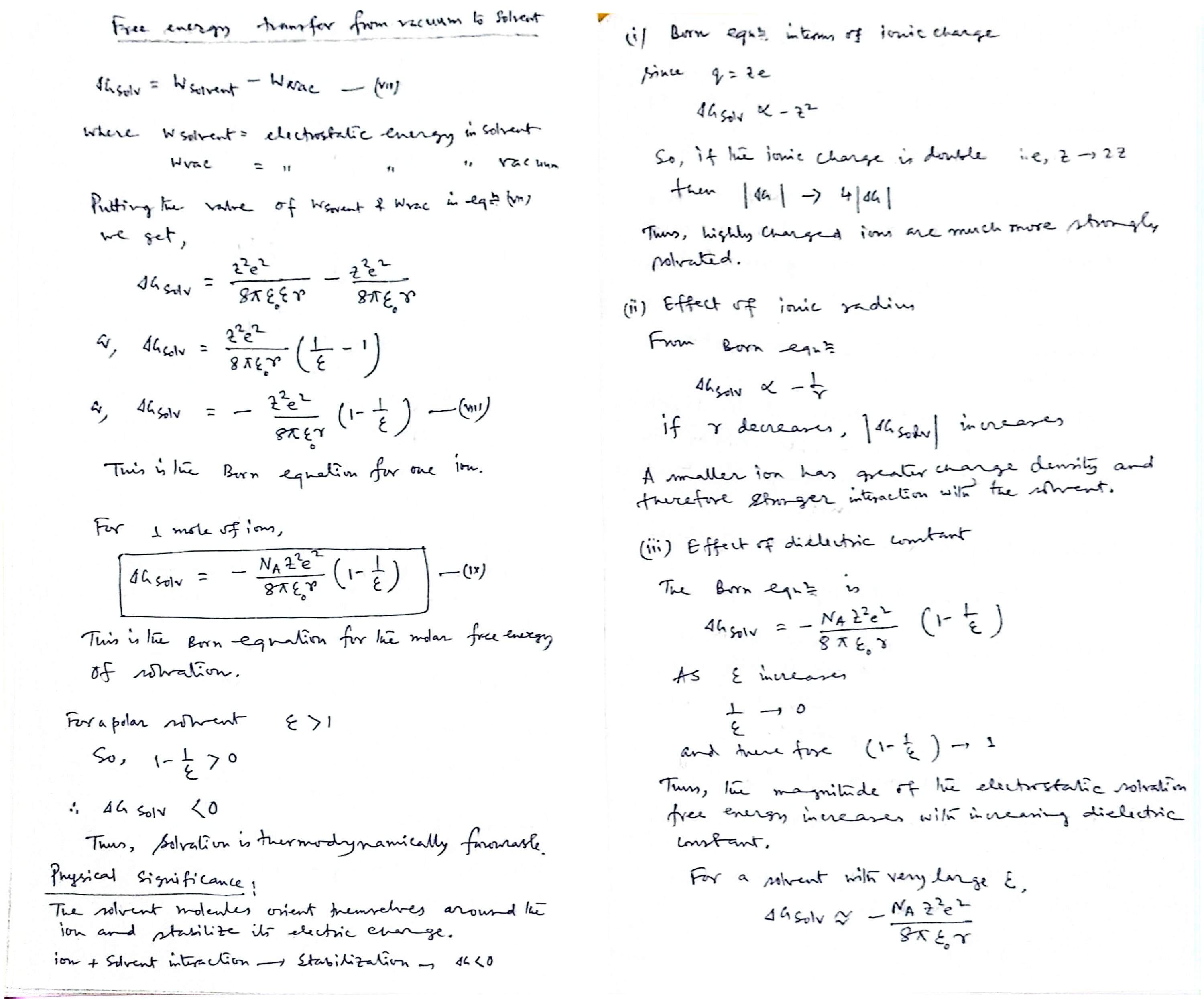 S4 · transfer (vii)–(ix) & effects